

We tend to imagine change happening in one dramatic moment.
A breakthrough. A realization. A powerful decision when everything suddenly clicks.
Those moments happen.
But most lasting change happens afterward.
One different response. One uncomfortable choice. One time doing the thing you said you were going to do.
Then another.
Eventually, something that once felt unfamiliar starts to feel a little more natural.
The Old Pattern Usually Had a Reason
When someone keeps doing something they desperately want to stop doing, I’m interested in why that response keeps winning.
Because usually, somewhere along the way, it did something for them.
Maybe it brought relief.
Comfort.
Pleasure.
Safety.
Escape.
Approval.
Maybe it helped them avoid conflict or quiet something they didn’t know how to deal with.
That doesn’t mean the behavior is still helping them now.
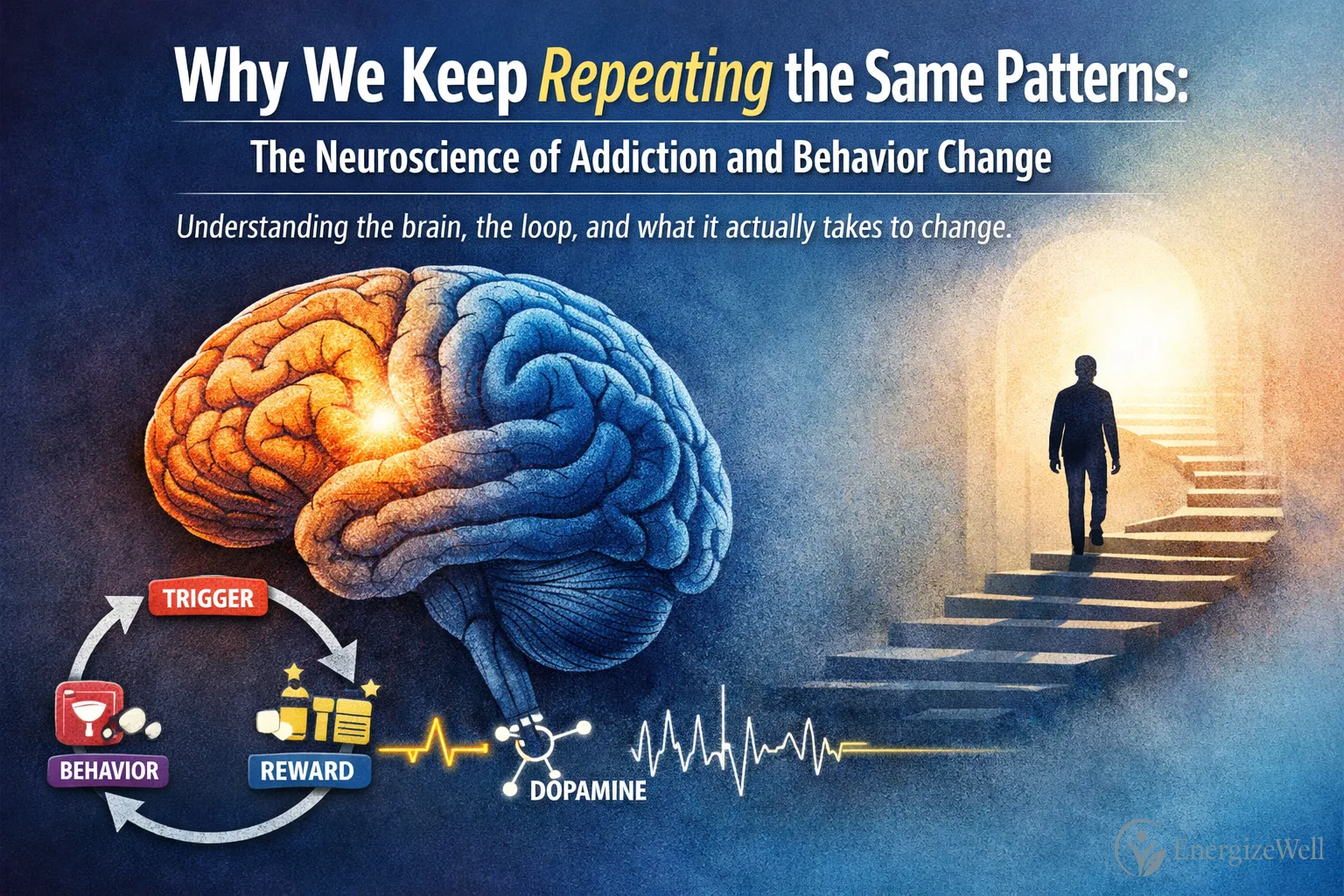
But our brains learn from what works, especially when something gives us relief or reward. The more often a response happens in a similar situation, the more familiar and automatic it can become.
A 2024 systematic review of health-related habits found that behaviors do become more automatic with repetition, but there isn’t one magical number of days when that happens. It varies quite a bit depending on the person and the behavior (Singh et al., 2024).
So sometimes the problem isn’t that you don’t know what you should do.
The old response simply has a lot more practice.
The Pattern Can Show Up in Your Body Too
We don’t experience patterns only as thoughts.
Sometimes your body seems to recognize what’s happening before you’ve consciously put words to it.
Your jaw tightens before you agree to something you don’t want to do.
Your stomach drops.
Your breathing changes.
Your shoulders rise.
You feel restless.
You want to escape, shut down, lash out, eat something, use something, or say yes before you’ve even stopped to ask yourself what you actually want.
That’s part of why body awareness matters to me.
You can’t choose differently in a moment you don’t realize is happening.
Sometimes the first change isn’t making the perfect choice.
It’s noticing:
Oh. I’m doing it again.
And that little bit of awareness creates room for something different.
Addiction Shows How Complicated Change Can Become
Addiction is not simply a really strong habit.
The American Society of Addiction Medicine recognizes addiction as a chronic, treatable medical disease involving brain circuits, genetics, environment, and life experiences. One of its defining features is that behavior can become compulsive, continuing even when someone sees the consequences and genuinely wants to stop (American Society of Addiction Medicine [ASAM], 2019).
Repeated substance use can affect systems involved in reward, motivation, stress, learning, and self-control.
Eventually, it may not be only an obsession, craving, or repeated thought.
It can become a compulsion.
That’s important because telling someone with addiction to “just make a better choice” misses an enormous part of what’s happening.
But addiction also shows us something important about change.
Even deeply established patterns are not the end of the story.
I’ve Watched People Practice a Different Life
I’ve spent close to 20 years around the recovery world, and I’ve watched people change in ways that still amaze me.
I’ve watched people who couldn’t stay out of jail or put down a drug pipe build years of sobriety and lives they’re proud of.
I’ve watched people move from homelessness into jobs, homes, and restored relationships.
I’ve watched people who were once so overwhelmed by fear and anxiety that leaving home felt almost impossible gradually begin going places again, return to work, build relationships, and create fulfilling lives.
I’ve watched people slowly change the way they eat until choices that once took enormous effort simply became part of normal life.
None of those people woke up one morning as a completely different person.
They practiced a different life.
That doesn’t mean addiction, anxiety, trauma, eating habits, and people-pleasing are all the same thing.
They’re not.
But there is a broader principle underneath them.
What we’ve repeatedly experienced and practiced has history behind it. The new response usually doesn’t.
Understanding the Pattern Isn’t Excusing It
Sometimes people hear compassion or curiosity and think we’re removing responsibility.
I don’t see it that way.
If someone keeps doing something they don’t want to do, I want to know:
What happens right before it?
What does the behavior give them?
What are they trying to avoid, feel, get, or accomplish?
What happens in their body?
What makes the alternative harder?
What could make a different response easier?
Understanding why a pattern developed doesn’t mean we have to keep letting it run our lives.
Compassion and accountability can exist at the same time.
Small Doesn’t Mean Meaningless
A different response can look almost ridiculously small at first.
You go for the ten-minute walk.
You don’t send the angry text.
You tell the truth.
You go to the meeting.
You eat the meal you planned.
You step outside.
You say no.
You ask for help.
You stay in the uncomfortable moment a little longer instead of immediately escaping it.
Did one decision transform your entire life?
Probably not.
But you practiced something different.
Then life gives you another opportunity.
And another.
The old pattern has history.
The new one needs experience.
Change Usually Needs Support Too
I also don’t want “one decision at a time” to become another version of just try harder.
People change inside environments.
Therapy can help.
Medication can help.
Recovery programs can help.
Coaching can help.
Community can help.
Relationships can help.
Sometimes changing the environment makes the new choice possible in the first place.
Sometimes someone needs treatment.
Sometimes they need a boundary.
Sometimes they need somebody beside them while they practice doing something they’ve never known how to do.
Change is personal, but it doesn’t have to be solitary.
A Different Way to Think About Change
When we expect transformation to be dramatic, slow progress can look like failure.
I’ve seen enough change to believe the opposite.
Sometimes slow is exactly what change looks like.
The person who stays sober for ten years starts with one day.
The person who eventually buys the house starts by saving a little from one paycheck.
The person who once couldn’t imagine leaving home because of fear starts by stepping outside.
The healthier way of eating begins with one meal.
The boundary begins with one uncomfortable no.
And over time, those moments add up.
The old response may still show up.
But maybe you notice it sooner.
Maybe you pause before acting on it.
Maybe you choose differently once out of ten times, and later it’s five.
Maybe you recover faster when you fall back into the old pattern.
That’s change too.
You don’t have to become a completely different person overnight.
The old pattern had practice. The new one needs practice too.
References
American Society of Addiction Medicine. (2019). Definition of addiction. https://www.asam.org/quality-care/definition-of-addiction
Singh, B., Murphy, A., Maher, C., & Smith, A. E. (2024). Time to form a habit: A systematic review and meta-analysis of health behaviour habit formation and its determinants. Healthcare, 12(23), 2488. https://doi.org/10.3390/healthcare12232488