

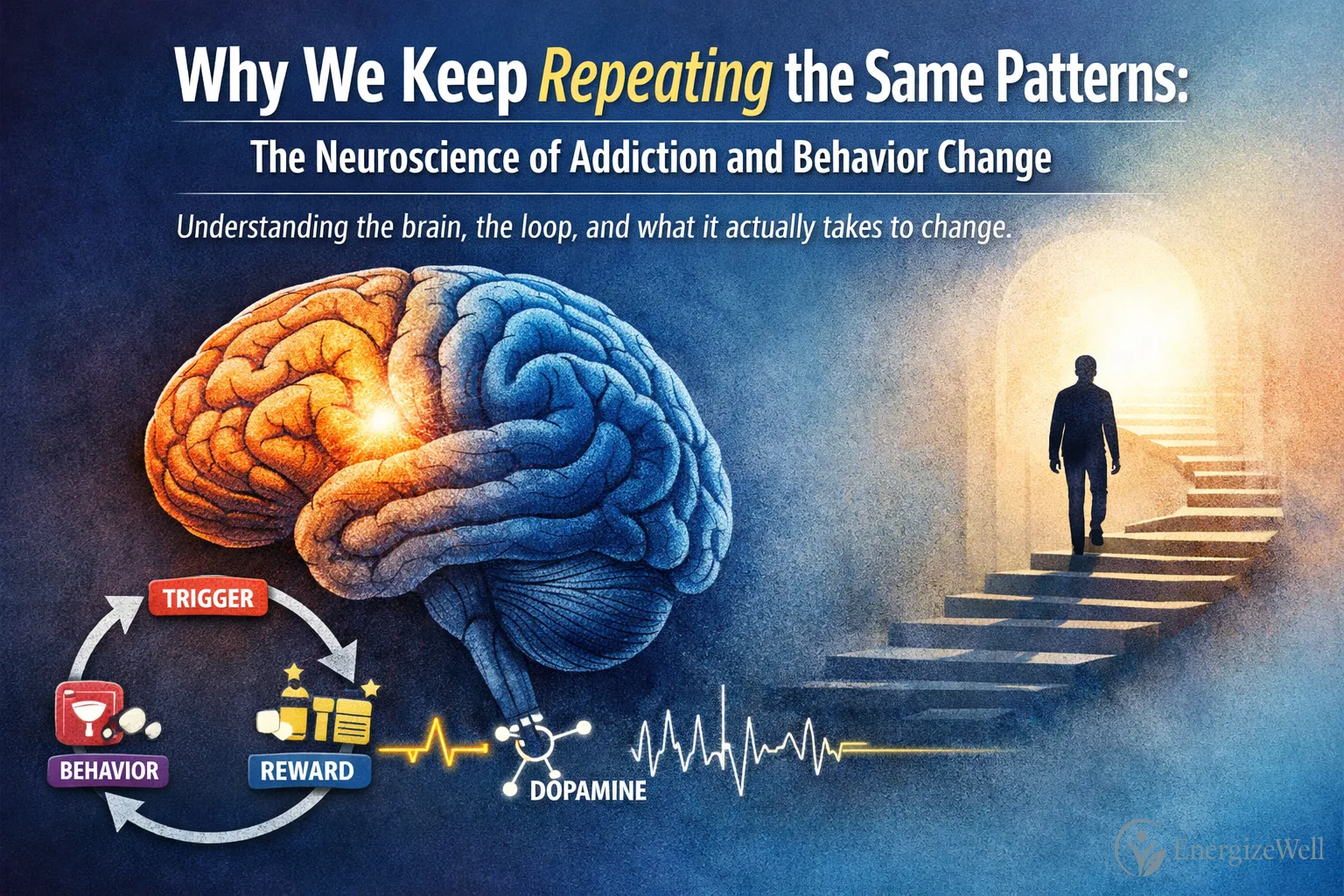
Addiction can be incredibly confusing.
Why would someone keep doing something that’s hurting them?
Why don’t consequences make them stop?
How can someone desperately want to quit and still go back?
And if you’ve experienced addiction yourself, you might have wondered:
Why can’t I just stop?
There isn’t one simple answer.
Addiction involves the brain, but it also involves the rest of the person. Genetics, stress, environment, relationships, mental and emotional health, trauma, access to support and our experiences all matter.
But understanding what’s happening in the brain can help explain why addiction can become so powerful.
And I think it can also give us some hope about recovery.
Your Brain Learns What Matters
Dopamine gets called the “feel-good chemical” all the time, but that’s an oversimplification.
Research shows that dopamine plays an important role in reward, motivation and learning. Addictive substances can strongly affect dopamine signaling in the brain’s reward system. With repeated use, the brain can also form strong associations between the substance and the cues surrounding it, such as certain people, places or situations (Volkow et al., 2019).
Basically, your brain is learning what matters.
And with addiction, it can get really good at learning what predicts the drug.
A certain person.
A place.
Payday.
An argument.
Being alone.
A smell.
A song.
Stress.
Those things can become connected to using.
So when a craving seems to come out of nowhere, it may not have come out of nowhere at all.
Your brain may have noticed something before you consciously connected the dots.
Wanting Something Isn’t the Same as Liking It
This is one of the more interesting things about addiction neuroscience.
Research has shown that with repeated substance use, cues connected to the substance can become extremely powerful. At the same time, the brain’s response to other rewards can become weaker, and the actual experience of the drug may not even be as rewarding as it once was (Volkow et al., 2019).
Basically, you can really want something you don’t even really like anymore.
Anyone who has experienced addiction probably understands how weirdly accurate that can be.
You can think:
I don’t even want to do this.
And still feel an incredible pull toward doing it.
That’s part of what makes addiction so confusing.
The Addiction Loop Gets Learned
At first, using might give you something.
Pleasure.
Energy.
Confidence.
Relief.
Numbness.
Escape.
Then your brain starts learning what leads to that result.
Cue → craving → use → effect
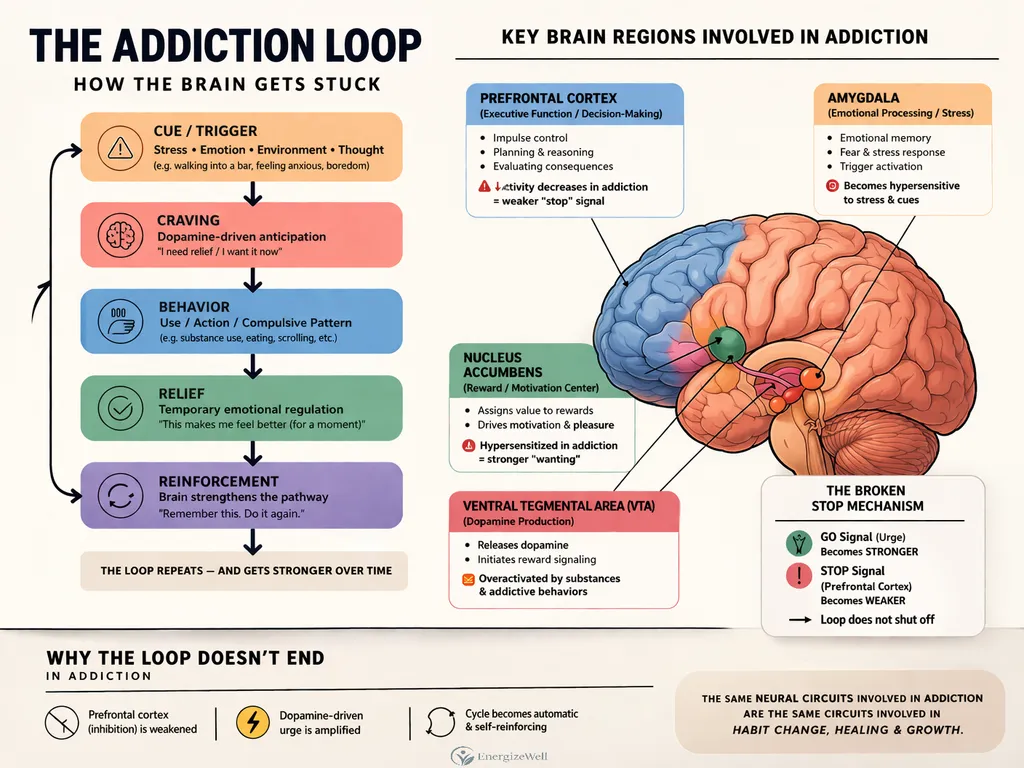
The more often that pattern happens, the more established it can become.
Eventually, the substance might not even give you what it used to.
But the cue can still trigger craving.
And the pattern can start happening almost automatically.
That’s why someone can know:
This is hurting my family.
I’m going to lose my job.
I promised myself I wasn’t going to do this again.
I don’t want to live like this.
And still use.
Knowing matters.
But knowing something is a terrible idea and being able to stop yourself from doing it aren’t exactly the same thing.
What Happens to the “Stop” Part of the Brain?
The actual neuroscience here is more complicated than one part of the brain saying “go” and another saying “stop.”
Research shows that addiction involves changes across several connected brain systems involved in reward, motivation, memory, stress, decision-making and self-control. The prefrontal cortex is especially important because areas within it help us evaluate consequences, make decisions and regulate behavior (Volkow et al., 2019).
Here’s the simple version.
The part yelling:
DO IT.
can get really loud.
Meanwhile, the part saying:
Hang on. Remember what happened last time?
can have a harder time getting through.
That doesn’t mean people with addiction don’t have choices.
And understanding the brain doesn’t mean removing responsibility for what we do.
But it does help explain something important:
Knowing better doesn’t automatically mean you’re able to do better yet.
That takes practice.
And often, support.
Addiction Isn’t Always About Getting High
Another thing that can change over time is why someone uses.
Research describes a shift that can happen as addiction progresses. Drug use may begin because of its rewarding effects, but continued use can increasingly become connected to escaping withdrawal, stress or other negative emotional states (Volkow et al., 2019).
Basically, at first you might use because you want to feel good.
Later, you might use because you don’t want to feel bad.
That’s a huge difference.
Someone may not be chasing some amazing high anymore.
They might be trying to stop feeling anxious.
Sick.
Agitated.
Empty.
Depressed.
Restless.
Or just not okay.
That doesn’t make continued use harmless.
But it helps explain why “Why don’t you just stop?” isn’t a particularly useful understanding of addiction.
Because stopping may be exactly what someone wants.
Their brain and body just might not be very happy about it yet.
Here’s the Really Hopeful Part
The brain changes with addiction.
But that isn’t the end of the story.
A 2022 systematic review looked at 45 longitudinal brain-imaging studies of people with substance use disorders during abstinence or substantial reductions in use. The majority of those studies found evidence of at least some recovery in brain structure, function or neurochemistry over time, although the amount and timing of recovery varied (Parvaz et al., 2022).
Basically: your brain can change again.
I think that’s incredibly important.
Because sometimes people hear “addiction changes your brain” and walk away thinking:
Dang. I broke my brain.
That’s not what the research says.
The brain is adaptable.
It learns.
And it can keep learning.
This Is Why the Boring Stuff Matters
Recovery often isn’t one giant life-changing moment.
A lot of it is doing something different when the old pattern shows up.
Call somebody.
Go to the meeting.
Take a different route home.
Eat something.
Get some sleep.
Tell the truth.
Leave the situation.
Sit with a craving without acting on it.
Feel like shit without immediately trying to make the feeling disappear.
Do something different.
Then do it again.
And again.
And again.
That doesn’t mean every recovery behavior literally creates a brand-new neural pathway every time you do it. The brain is much more complicated than that.
But experience and repetition are part of how the brain learns.
The patterns we repeatedly practice matter.
Recovery Is Bigger Than the Brain
As much as I love understanding the neuroscience, I don’t think we should reduce addiction or recovery to what happens in the brain.
People aren’t just brains.
Recovery can involve medical care, medication, therapy and treatment.
It can also involve sleep, nutrition and movement.
Relationships.
Recovery communities.
Faith.
Purpose.
Boundaries.
Honesty.
Learning how to feel things you spent years trying not to feel.
Repairing relationships when repair is possible.
Building new ones.
Finding people you can call when your own thinking isn’t serving you particularly well.
And eventually, building a life you don’t constantly need to escape from.
There isn’t one tool that addresses every part of a human being.
That’s why I believe recovery needs to look at the whole person.
What About Phones, Food, Shopping and Other Habits?
We use the word “addicted” pretty casually now.
I’m addicted to my phone.
I’m addicted to sugar.
I’m addicted to shopping.
Some everyday behaviors do involve reward, learning, cues and habits, which overlap with systems involved in substance addiction.
But that doesn’t mean every habit we struggle to control is neurologically the same as a substance use disorder.
That’s an important distinction.
Still, understanding the basic loop can help us get curious about our behavior.
What happens right before I do this?
What am I hoping this gives me?
Relief?
Stimulation?
Comfort?
Escape?
Connection?
And what happens afterward?
Sometimes understanding the pattern is much more useful than deciding we’re lazy, weak or lacking discipline.
Your Brain Is Part of Your Story. It Isn’t the Whole Story.
Neuroscience can help explain addiction.
But a brain scan can’t show someone’s entire life.
It can’t show grief.
Relationships.
Loss.
Shame.
Faith.
Hope.
The person who kept answering the phone.
The first meeting someone was terrified to walk into.
The apology.
The boundary.
The hundred little decisions nobody else saw.
Or the moment someone started believing their life might actually be worth fighting for.
The brain matters.
So does everything happening around it.
And I think one of the most hopeful things neuroscience gives us isn’t an excuse for addiction.
It’s evidence that change is possible.
Your brain learned.
Your brain adapted.
And your brain isn’t finished learning yet.
References
Parvaz, M. A., Rabin, R. A., Adams, F., & Goldstein, R. Z. (2022). Structural and functional brain recovery in individuals with substance use disorders during abstinence: A review of longitudinal neuroimaging studies. Drug and Alcohol Dependence, 232, 109319. https://doi.org/10.1016/j.drugalcdep.2022.109319�
Volkow, N. D., Michaelides, M., & Baler, R. (2019). The neuroscience of drug reward and addiction. Physiological Reviews, 99(4), 2115–2140. https://doi.org/10.1152/physrev.00014.2018�
What Is Addiction?
Addiction is not just about doing something over and over.
It’s about a pattern that the brain has learned, reinforced, and prioritized.
Many people think addiction is a choice. But it’s not that simple.
Addiction changes the brain’s wiring in a way that makes certain behaviors feel necessary, not optional.
The brain keeps sending signals that say:
👉 “Do this again. This matters.”
And over time, that signal gets louder than logic.
How Does the Brain Work?
The brain is like a computer. It controls everything we do. It helps us think, feel, and move. The brain has many parts. One important part is the reward system. This system helps us feel good when we do things like eating or playing. It helps us learn what is good for us.
The reward system uses a chemical called dopamine.
Dopamine isn’t just about pleasure.
It’s about motivation and learning.
It tells the brain:
👉 “This matters. Remember this. Do this again.”
This is how habits are formed.
The same system that helps you build a workout routine… is the same system that reinforces addiction.
You don’t have to be an addict to understand this.
Have you ever tried to:
stop scrolling your phone,
stop overthinking,
stick to a nutrition plan,
or leave something you know isn’t right…
and still found yourself going back?
That’s not a lack of discipline.
That’s your brain doing exactly what it was trained to do.
What Happens in the Brain During Addiction?
When a person uses drugs or alcohol, the brain releases a large amount of dopamine. This makes the person feel very good. The feeling is stronger than natural rewards like food or fun. The brain remembers this feeling.
Over time, the brain changes. It makes fewer dopamine receptors. This means the brain feels less pleasure from normal things. The person needs more drugs to feel good. This is called tolerance.
But there’s another shift happening that’s even more important.
The brain has a built-in “stop system.”
Under normal circumstances, this system helps you pause, evaluate, and say:
👉 “That’s enough.”
In addiction, that system starts to weaken.
The signal that says “go” gets stronger…
while the signal that says “stop” gets quieter.
This creates a loop:
urge → action → relief → repeat
And because the stop mechanism isn’t working the same way…
the loop doesn’t naturally end.
This is why addiction can feel like being stuck on repeat… even when part of you desperately wants to stop.
Also, the brain changes in other ways. The part of the brain responsible for decision-making and self-control, called the prefrontal cortex, becomes less active.
This makes it harder to pause, think long-term, and choose differently.
So even when someone knows something is harmful… the urge can override that knowing.
This is why you can know what to do… and still not do it.
That gap isn’t a character flaw.
It’s a brain state.
Credit: energizewell.com
More In-Depth Neuroscience: Why the Loop Doesn’t Shut Off
Addiction is not just about dopamine. It involves a shift in how different parts of the brain communicate and regulate behavior.
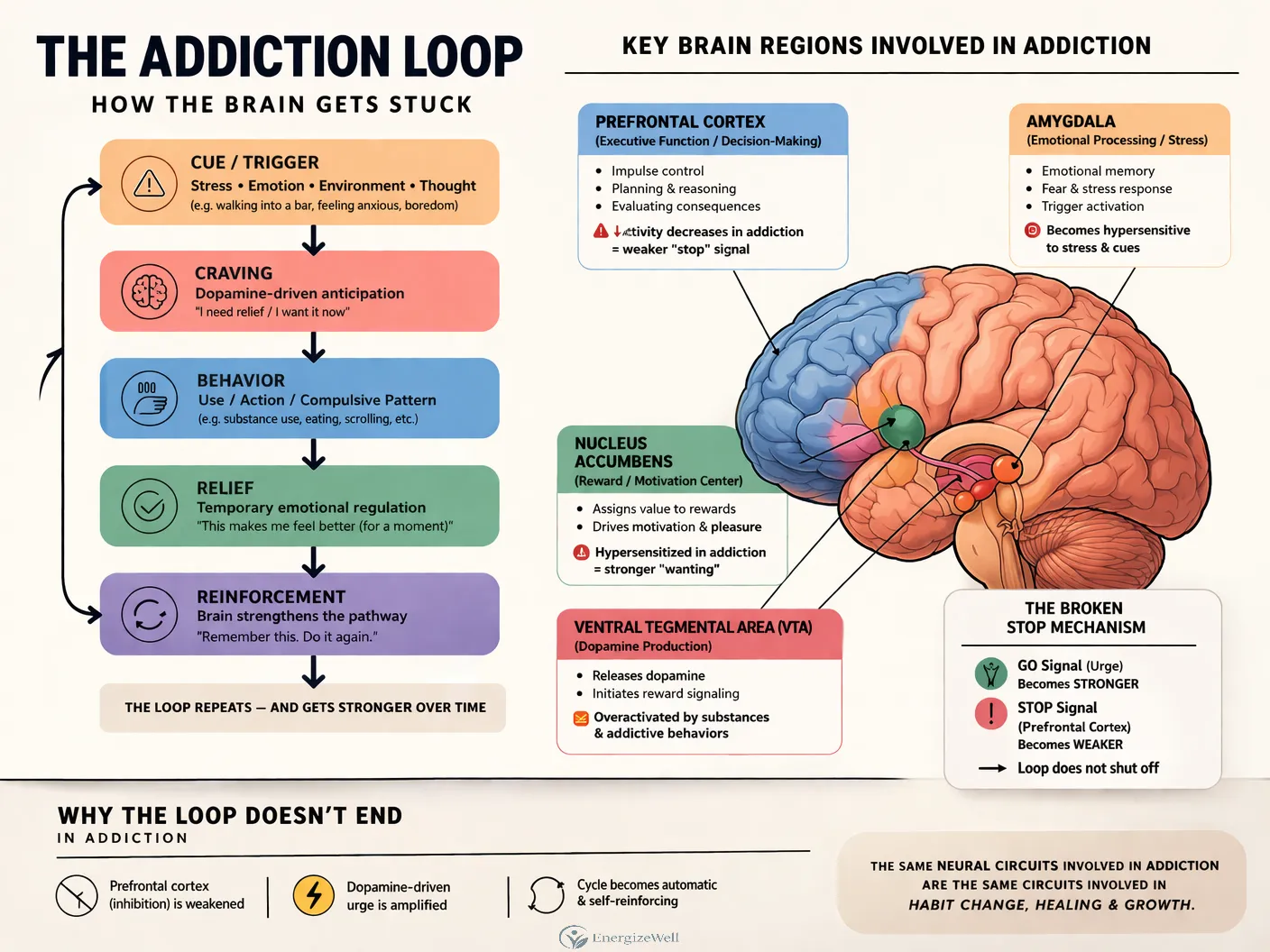
The mesolimbic dopamine system, which includes the ventral tegmental area (VTA) and nucleus accumbens, becomes highly activated. This system is responsible for assigning value and driving motivation. In addiction, it becomes hypersensitized, meaning cues, stress, or memories can trigger strong urges even without the substance present.
At the same time, the prefrontal cortex, which is responsible for executive function, impulse control, and long-term decision-making, becomes less active.
This creates a functional imbalance:
- The nucleus accumbens drives motivation and reinforcement
- The prefrontal cortex is less able to regulate and inhibit behavior
This is often described as a breakdown in top-down inhibitory control.
In simple terms, the system that says “this matters, do it again” becomes stronger than the system that says “pause and think.”
Because of this, the loop does not naturally shut off.
Behavior becomes:
- more automatic
- more cue-driven
- less responsive to logic or consequences
This is why someone can fully understand the impact of their behavior and still feel unable to stop.
Why Is Addiction So Hard to Stop?
Addiction is hard to stop not because someone lacks willpower, but because the brain systems that drive behavior have changed.
The brain’s reward system becomes hypersensitized, meaning cues, stress, or even memories can trigger strong urges. These urges are not just mental, they are physical and neurological.
At the same time, the prefrontal cortex, the part of the brain responsible for decision-making, impulse control, and long-term thinking, becomes less active.
This creates a functional imbalance in the brain.
The system that drives behavior becomes stronger, while the system that is supposed to regulate and stop behavior becomes weaker.
Because of this, the loop does not naturally shut off.
Even when someone understands the consequences, even when they truly want to stop, the urge can override that awareness.
This is often referred to as impaired inhibitory control, meaning the brain has a harder time pausing, evaluating, and choosing a different response.
Over time, the behavior becomes more automatic and less conscious.
This pattern is not unique to addiction.
The same brain circuitry is involved in overeating, overthinking, procrastination, compulsive phone use, and emotional avoidance.
The difference is not the presence of the loop, it is how strongly it has been reinforced.
In all of these patterns, the brain learns through repetition:
This works. Do it again.
And eventually, the behavior becomes automatic.
This is not a failure of willpower. It is a learned neurological pattern that has been reinforced over time.
Can You See Yourself in This?
You might not identify with the word addiction.
But you may recognize the pattern.
Have you ever found yourself:
reaching for your phone without thinking
replaying the same thoughts over and over
eating when you’re not physically hungry
avoiding something you know would move your life forward
You tell yourself you’ll do something different next time.
But then the moment comes…
and you don’t.
Not because you don’t care.
Not because you’re not trying.
But because the pattern is already in motion.
A cue triggers a feeling.
The feeling creates an urge.
The urge drives a behavior.
The behavior brings temporary relief.
And your brain learns:
this works… do it again.
Over time, this becomes automatic.
This is how patterns form.
This is how they get reinforced.
And this is why they can feel so hard to change.
The same loop that drives addiction exists in everyday life.
The difference is not whether you have the loop.
It’s how deeply it has been reinforced…
and whether you have the tools to interrupt it.
Awareness alone doesn’t change the pattern.
Change happens when the loop is disrupted,
and a new response is practiced repeatedly over time.
How Can We Help the Brain Heal?
The brain is not fixed. It is adaptable.
This is known as neuroplasticity, the brain’s ability to change, rewire, and form new pathways over time.
Even after addiction, the brain can begin to restore balance. But this does not happen automatically. It happens through consistent changes in behavior, environment, and support.
Healing the brain involves both reducing reinforcement of the old pattern and building new ones.
Some of the most effective ways to support this process include:
- Interrupting the loop
Learning to recognize cues and disrupt the automatic sequence before it completes - Creating new responses
Replacing the behavior with something that regulates the body in a different way - Repetition over time
New patterns only become strong through consistent practice - Regulating the nervous system
Practices like movement, breathwork, rest, and connection help reduce the intensity of urges - Supporting the brain through physical health
The brain is part of the body, and its ability to regulate, recover, and function depends on basic physiological support.
Nutrition, sleep, hydration, and movement all play a role in stabilizing mood, improving cognitive function, and supporting neurotransmitter balance.
When the body is depleted, stressed, or undernourished, urges tend to feel stronger and harder to manage.
Stabilizing blood sugar, getting adequate protein, and supporting overall nutrient intake can help reduce reactivity and improve the brain’s ability to regulate impulses. - Support and structure
Therapy, treatment programs, and support groups provide external regulation while the brain is healing
The brain does not heal in isolation. It heals within the context of the whole body.
Over time, these changes help strengthen the prefrontal cortex and restore more balance between the brain’s “go” and “stop” systems.
The urges may still appear, but they become less intense, less automatic, and more manageable.
An Important Truth About Recovery
For many people, stopping substance use doesn’t immediately reset the body or mind back to baseline.
Because the brain has already learned and reinforced the pattern, even a single return to use can quickly reactivate the same loop.
This is why many people find that they cannot safely return to drinking or drug use in a controlled way.
The brain remembers.
And once that pathway is reactivated, the cycle can pick up where it left off.
This is not a failure.
It is how the brain has been wired through repeated reinforcement.
Healing does not mean the pattern never existed. It means new pathways have been built that are stronger than the old ones.
Where to Find Support and Real Stories
If you are looking for real stories, support, or a place to start, there are communities built around exactly this.
These spaces offer connection, shared experience, and a reminder that you are not alone in what you are facing.
Some options include:
- Alcoholics Anonymous (AA)
A long-standing recovery community focused on support, structure, and shared experience - Narcotics Anonymous (NA)
Similar to AA, with a focus on recovery from substance use of all kinds - Al-Anon
Support for family members and loved ones affected by someone else’s addiction - Celebrate Recovery
A faith-based program that addresses a wide range of struggles, including addiction, habits, and emotional patterns - Health Realization / Three Principles-based communities
Focus on understanding thought, awareness, and the mind as a pathway to change
There is no single path that works for everyone.
What matters is finding a space where you feel supported, understood, and willing to keep showing up. Sometimes the first step is simply being around people who understand what you’re going through.
How Can You Support Someone with Addiction?
Supporting someone with addiction is not about fixing them. It is about creating an environment that supports safety, accountability, and change.
Here are some meaningful ways to help:
Listen without judgment
Create a space where they can be honest without fear of shame. Feeling understood can reduce isolation and defensiveness.
Encourage professional support
Treatment programs, therapy, and medical care can provide structure and tools that are difficult to build alone.
Set and maintain clear boundaries
Support does not mean enabling. Healthy boundaries protect both you and the other person while reinforcing responsibility.
Understand triggers and patterns
Learning what situations, emotions, or environments increase risk can help reduce exposure and prepare for difficult moments.
Support healthy routines
Encourage sleep, nutrition, movement, and daily structure. These help stabilize mood and improve the brain’s ability to regulate behavior.
Be consistent and patient
Change takes time. Progress is not always linear, and setbacks can happen. Consistency matters more than perfection.
Take care of yourself
Supporting someone with addiction can be emotionally demanding. Your own well-being, boundaries, and support system are just as important.
You cannot control someone else’s choices, but you can create an environment that supports change.
Frequently Asked Questions
What Is Addiction From A Neuroscience Perspective?
Addiction changes brain circuits tied to reward, motivation, and memory. These changes make stopping very hard. The brain craves substances or behaviors like never before.
How Does Addiction Affect The Brain’s Reward System?
Addiction floods the brain with dopamine, a feel-good chemical. Over time, normal rewards feel less exciting. This leads to stronger cravings and repeated use.
Why Do Some People Get Addicted More Easily?
Genetics, brain chemistry, and environment shape addiction risk. Stress and trauma also increase vulnerability. Not everyone’s brain reacts the same way.
Can Addiction Rewire The Brain Permanently?
Addiction can cause long-lasting brain changes but not always permanent. The brain can heal with time and treatment. Recovery helps restore balance and control.
Conclusion
The neuroscience of addiction shows that addiction is a brain disease. It changes the reward system and control centers in the brain. These changes make quitting hard. But the brain can heal.
Treatment, support, and healthy habits help people recover. Addiction is not a failure. It is a challenge that many face. With hope and help, people can live better lives.
If you or someone you know struggles with addiction, remember: help is available. The brain can change. Recovery is possible.
Sources: